

06 Export
Stone export from Armenia
How we pack and document stone shipments: crates, A-frames and pallets in ISPM-15 treated timber where the destination requires it. Terms are agreed per order.
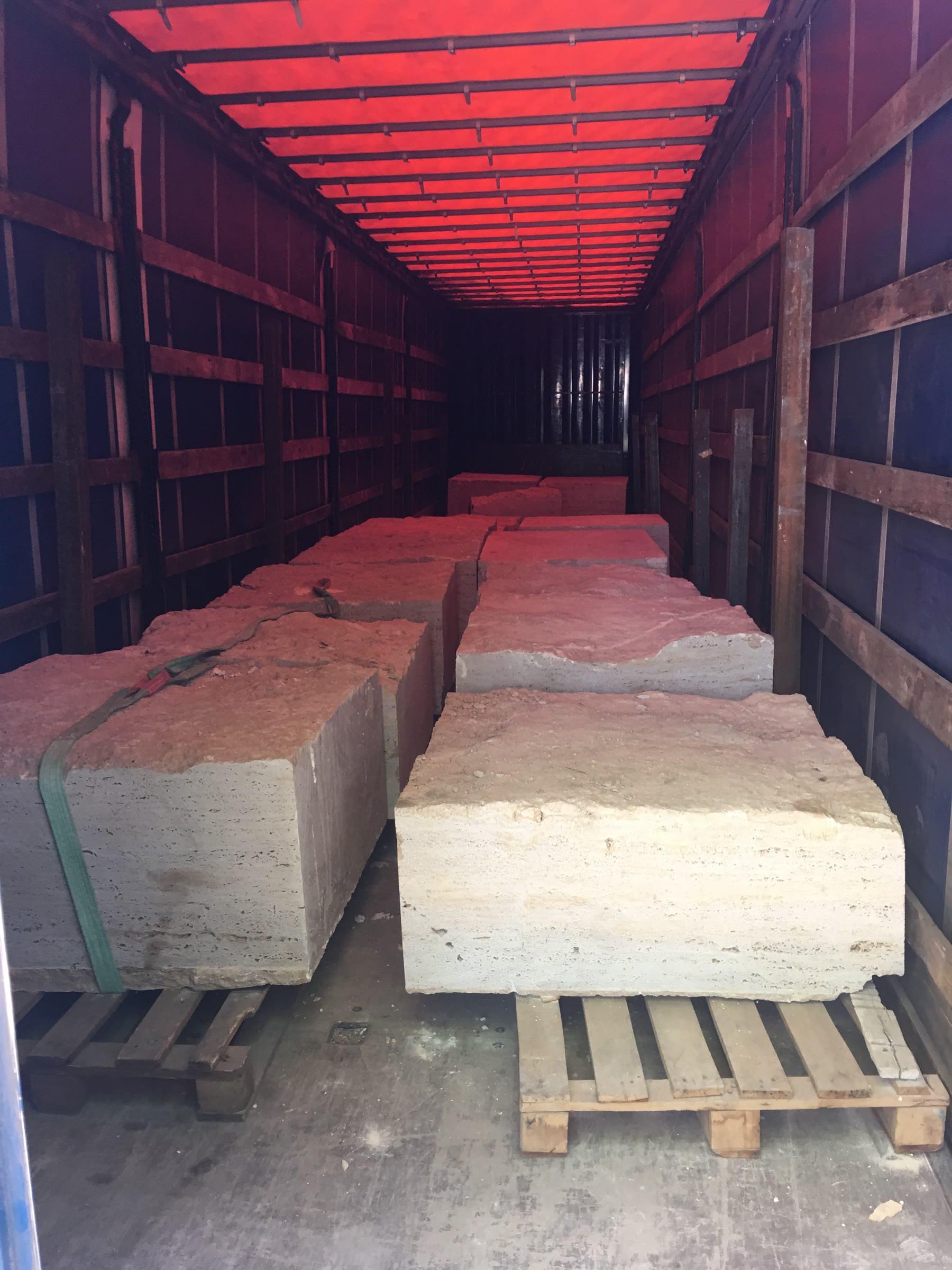
01 Shipments
How a shipment is prepared
Stone is dense and heavy, so how it is packed, loaded and documented decides whether it arrives intact and clears the border.
- 01
Packing
Crates, A-frames and pallets chosen for the product, with edge protection. Export packing uses ISPM-15 treated timber where the destination requires it.
- 02
Loading
Containers and trucks, with the load blocked and braced so that nothing moves in transit.
- 03
Documents
The documents your destination requires, prepared with the shipment and confirmed for each order.
- 04
Transport
By road and by sea. Delivery is quoted on the basis you choose.
- 05
Your forwarder
If you work with your own freight forwarder, we coordinate the collection and the paperwork with them.
02 Packing
Packing for the route
Most transit damage comes from three causes: movement inside the load, impact during handling, and moisture. Packing is designed against all three, and it differs by product.
Slabs
Bundles on an A-frame
- Timber A-frame, ISPM-15 treated where required
- Film, paper or foam between slabs
- Straps and bracing
Long and carved pieces
Individual crates
- Crate in timber, marked with the piece mark
- Internal bracing and spacers
- Piece supported along its full length
Tiles and pavers
Pallets
- Pallet in timber, ISPM-15 treated where required
- Corner and edge protection
- Straps and wrap
Typical packing by product
- Blocks
- On timber bearers or pallets that spread the weight, blocked and braced against movement.
- Slabs
- In bundles kept in sequence, separated with film, paper or foam, on A-frames or in crates.
- Tiles and strips
- In cartons or crates, face to face with protection between, strapped on pallets with corner protection.
- Pavers
- Palletised and strapped, or crated. Size and weight limit the number per pallet.
- Steps and long elements
- Wrapped individually and crated with internal bracing, supported along the full length.
- Carved and architectural elements
- Crated individually, with the spaces filled and the piece mark from the drawing on the crate.
Typical practice for natural stone. We confirm the exact packing for each order.
03 Delivery basis
What the delivery terms mean
The delivery basis sets who arranges and pays for each stage of the journey, and the point at which the risk passes from seller to buyer. We confirm the basis in each quotation. Tell us the one you prefer, or the point where you want to take over responsibility, and we state what the quotation is based on.
Incoterms 2020 are rules published by the International Chamber of Commerce. They allocate tasks, costs and risk between seller and buyer, and they do not transfer ownership of the goods or settle payment. This is a short summary of eight of the rules. It explains what each term means. It is not a list of the terms we offer.
Where the risk passes to the buyer
-
Seller’s premises
EXW
-
Handover to the carrier
FCA · CPT · CIP
-
On board at the port of loading
FOB · CFR · CIF
-
Named place of destination
DAP
| Term | What the seller does | Risk passes to the buyer | Main carriage | Export clearance | Insurance the rule requires |
|---|---|---|---|---|---|
| EXW Ex Works Any mode of transport | Makes the goods available at its premises or another named place. Does not load them. | When the goods are made available | Buyer | Buyer | None |
| FCA Free Carrier Any mode of transport | Hands the goods, cleared for export, to the carrier the buyer names at a named place, and loads them if that place is its premises. | On handover to the buyer’s carrier | Buyer | Seller | None |
| CPT Carriage Paid To Any mode of transport | Pays carriage to the named destination and hands the goods, cleared for export, to the first carrier. | On handover to the first carrier | Seller | Seller | None |
| CIP Carriage and Insurance Paid To Any mode of transport | As CPT, and also insures the goods to the named destination with a minimum of all-risks cover (Institute Cargo Clauses A). | On handover to the first carrier | Seller | Seller | Seller |
| FOB Free On Board Sea and inland waterway only | Loads the goods, cleared for export, on the vessel the buyer names at the named port of loading. | When the goods are on board | Buyer | Seller | None |
| CFR Cost and Freight Sea and inland waterway only | Loads the goods on board at the port of loading and pays the sea freight to the named port of destination. | When the goods are on board at the port of loading | Seller | Seller | None |
| CIF Cost, Insurance and Freight Sea and inland waterway only | As CFR, and also insures the goods with a minimum of basic cover (Institute Cargo Clauses C). | When the goods are on board at the port of loading | Seller | Seller | Seller |
| DAP Delivered at Place Any mode of transport | Delivers the goods to the named place, ready for unloading on the arriving vehicle, and pays carriage to that place. | When the goods are ready for unloading at the named place | Seller | Seller | None |
Under all eight terms the buyer handles import clearance, duties and taxes.
For containerised cargo, FCA, CPT and CIP usually fit better than FOB, CFR and CIF, because a container is normally handed to the carrier at a terminal before it is loaded on board.
04 Documents
Documents with the shipment
We prepare the documents your destination requires. The set is confirmed for each order, so list the ones your country asks for in your enquiry and they are prepared from the start.
- 01
Commercial invoice
Describes the goods and their value for customs.
- 02
Packing list
Links every mark on the crates and pallets to its contents, with dimensions, quantities and weights.
- 03
Certificate of origin
Where the destination requires one.
- 04
Other documents
Whatever else your country requires for import.
Test reports and certificates for the stone itself are a separate matter. See certificates and documents
05 Destination
Where should we deliver?
Tell us where the stone goes. The quote request opens with your answers filled in, and nothing is sent yet.
Also useful to tell us
- The delivery terms you prefer, if you have a preference
- Whether you use your own freight forwarder
- How trucks reach the site and what unloads them
- Whether your country requires ISPM-15 treated timber
06 Questions
Export questions
01 How is stone packed for export?
Packing depends on the product: blocks, slabs, tiles and shaped pieces are protected and secured differently. Export packing uses ISPM-15 treated timber where the destination requires it. State any special packing or marking requirement in the enquiry, and we confirm the packing for your order.
02 How do you handle delivery to my country?
Export orders are quoted for each destination. Tell us the country, the port or the site address, and the delivery terms you prefer. We confirm the route and the delivery basis in the quotation.
03 Which delivery terms can you quote?
Tell us the delivery terms you prefer and the destination. We confirm the delivery basis in the quotation.
04 How long do production and delivery take?
It depends on the stone, the format, the finish, the quantity and the destination. We confirm the timing in the quotation, so state the date you need the material when you send the enquiry.
Request for quotation
Tell us what you need.
Stone. Dimensions. Quantity. Destination.
We will prepare the quotation for your project.
Or write to sales@petro-stone.am