

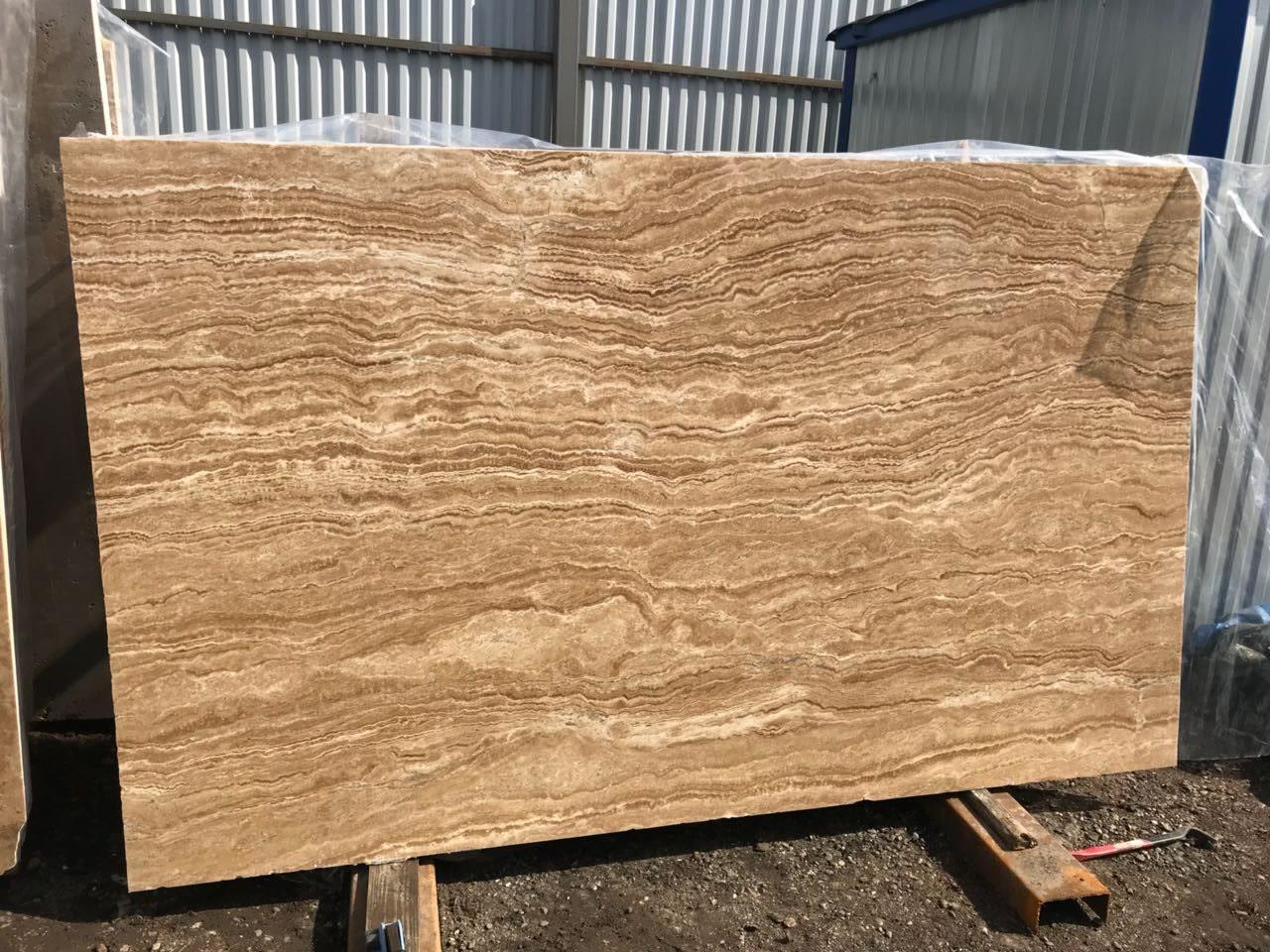
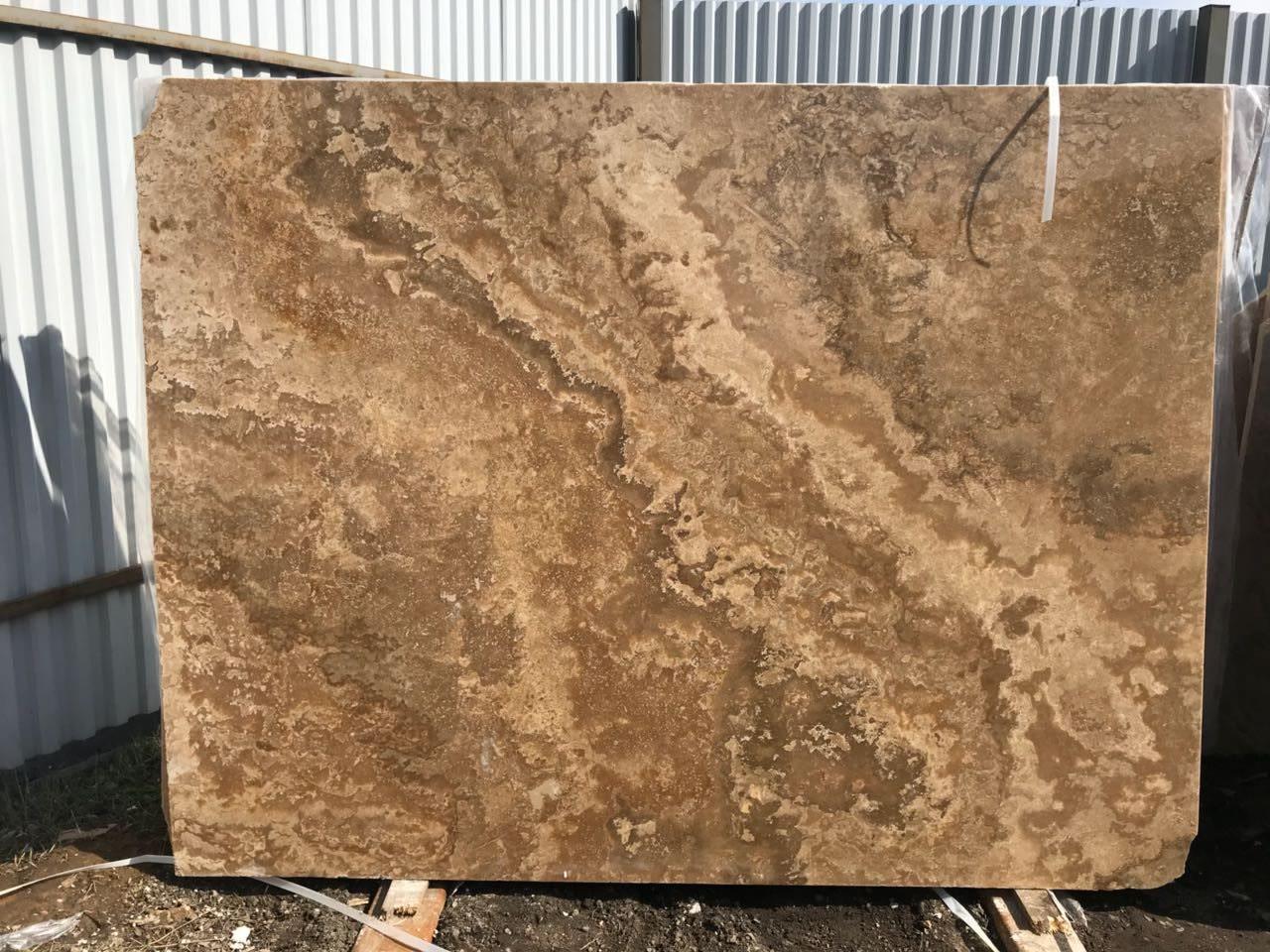
Two choices define the look of sawn travertine before any finish is applied: the cut and the pore treatment. Both are decided in production and cannot be changed afterwards, so they belong in the specification from the start. This guide explains what each one means and how to state it.
Why the cut matters
Travertine forms where mineral-rich spring water deposits calcium carbonate, layer on layer. The layers show up as bands. The voids left by escaping gas and plant material show up as pores. A block can be sawn in more than one orientation relative to those layers, so the same block can give slabs with very different faces. The two orientations in common use are vein cut and cross cut.
Trade terms vary a little between suppliers and regions. The safest way to specify a cut is to describe the pattern you want and to approve a photograph or a sample from current production.
Vein cut
In a vein cut, the layers appear as long, roughly parallel bands. The pattern has a clear direction, and the pores tend to appear as narrow, elongated voids that follow the bands.
What to expect:
- A linear, orderly look that suits architectural layouts.
- A visible direction. Decide whether all pieces run the same way or alternate. For cladding, decide whether the bands run horizontally or vertically, because the two read very differently.
- Pieces from the same block usually look similar to one another.
- A lighter or darker band can run across several neighbouring pieces, so keep pieces in sequence if continuity matters.
Cross cut
In a cross cut, the same layering appears as a cloudy, mottled pattern with no strong direction. The pores tend to look rounder and more scattered.
What to expect:
- A softer, more varied surface, with no direction to manage in the layout.
- More difference from piece to piece, because the cloud pattern changes across the block.
- A more informal look than vein cut, with the pattern less tied to the shape of the piece.
- Blending packs during installation matters more, so that clouds do not gather into patches.
How the cut shows in each format
On slabs, the pattern runs across the whole face, and consecutive slabs from one block continue it. Keep them in sequence if the surface should read as one piece.
On tiles, the pattern is cut into modules, so direction becomes a laying decision: all tiles aligned, or alternating. For French pattern sets, ask how the banding is oriented in each size, so that the layout reads as you intend.
On pavers, steps and sills, the cut decides which face shows the pattern. In layered stone, the orientation of the bedding relative to the exposed face can also affect how a piece weathers and carries load. For exterior pieces, say which face is the top face and ask which orientation is supplied.
Choosing between them
Choose vein cut when you want a linear, orderly surface and are prepared to control the direction of the bands. Choose cross cut when you want a cloudy surface without a direction to manage. For long runs of facade or large floors, compare samples from more than one block before you decide.
Strength can differ with the direction of the layers in sedimentary stone. For thin cladding, anchor fixings and other structural uses, ask for test data in the orientation that matches your use.
Both cuts are standard for our travertine. Confirm the combination of cut, pore treatment and finish on a sample.
Filled and unfilled pores
Pores are part of what makes travertine travertine. They form as the stone is deposited, and they are present in every block. The pore treatment decides what happens to them in the finished piece.
Filled
The voids are filled with a filler matched to the tone of the stone, and the surface is then ground flat. The filler is commonly cement-based or resin-based. The result is a closed, even surface that is easier to clean and that suits polished and honed finishes.
Points to check:
- The filler can differ slightly from the stone in tone or hardness.
- It can wear or loosen in places with heavy traffic.
- Resin fillers can react to heat or ultraviolet light.
If the exposure is demanding, such as an exterior floor or underfloor heating, ask what filler is used.
Unfilled
The voids are left open. The surface keeps its natural, textured character, and it is often chosen where an open, rustic look is wanted, for example on paving and on antiqued surfaces.
Points to check:
- Open pores collect dirt and water, so cleaning is harder.
- On floors, voids can catch heels and debris.
- Some installers fill the voids with grout during installation. Agree who does this, and with which grout.
- Outdoors, water held in open pores matters in freezing weather, so drainage and test data deserve attention.
Pore treatment and finish
Pore treatment and finish are chosen separately, but some pairs are common. Polished and honed surfaces are usually filled. Antiqued, brushed and tumbled surfaces are often left unfilled. Bush-hammered, sawn and split-face surfaces can be either. Treat this as guidance and confirm the exact combination on a sample. The guide to natural stone finishes describes each finish.
Common misunderstandings
- Vein cut does not mean the stone has veins and cross cut does not. Both show the banding of the stone, in different ways.
- Filled is not better than unfilled, and unfilled is not a defect. They are different surfaces for different uses.
- A cut name does not fix the colour. Tone is chosen separately.
- A photograph shows one slab, not a whole order. Natural variation applies to both cuts.
How to specify
Write the three decisions as one line in your RFQ. For example: travertine, light tone, vein cut, filled, honed, tiles to the size list attached. Add a reference photograph of the pattern you want, and say how much variation you accept.
If you are still choosing, ask for samples of both cuts and both pore treatments side by side. Look at them in the light of the project, and wet them. The sample form takes the stone, the tone, the finish and the size you want to see.
Related pages: travertine, finishes, slabs and tiles and strips. When your specification is ready, send it through the RFQ form.